<!doctype html>
Why Your Electric Bill Spikes When Your AC Needs Service | Phoenix, AZ
Why Your Electric Bill Spikes When Your AC Needs Service
In Phoenix, Arizona, cooling is not a luxury. It is life-safety. When the meter spins faster than usual, the air conditioner often tells a story. A system in distress pulls more amps, runs longer, and sheds less heat per kilowatt. That is why bills jump before a full breakdown. This article explains the physics, the parts, and the local stressors that push energy use up in Valley homes and businesses.
Day & Night Air Conditioning, Heating, & Plumbing services the Phoenix metro and the wider Maricopa County corridor. The team sees these patterns every week from Ahwatukee Foothills to Arcadia and Biltmore, from Desert Ridge to Sunnyslope and Maryvale. The insights below come from hands-on field diagnostics in homes near Camelback Mountain, small businesses by the Arizona State Capitol, and condos close to Phoenix Sky Harbor International Airport.
How a Phoenix AC turns electricity into comfort
A central air conditioner moves heat from inside to outside. The refrigerant absorbs heat in the evaporator coil, then rejects it at the condenser coil. The HVAC compressor raises refrigerant pressure and temperature. The outdoor fan and coil shed that heat to the desert air. The indoor blower motor pushes air across the cold evaporator coil, then through the ducts to each room.
When any stage in that cycle chokes, energy use climbs. The compressor runs longer. The blower works harder to move air through restrictions. The condenser fan spins under heavier thermal load as the sun bakes a rooftop unit in August. The meter reflects that drag. In Phoenix heat, the rise can be steep because ambient air sits above 110°F on many afternoons, and attic spaces often reach 140 to 160°F.
The most common faults that drive up kWh in Phoenix homes
Several issues repeat across Phoenix zip codes like 85032, 85050, 85018, and 85044. Some start small. Many show up first as a higher bill. The next week brings warm air, short cycling, or a tripped breaker.
Dirty condenser coils increase head pressure
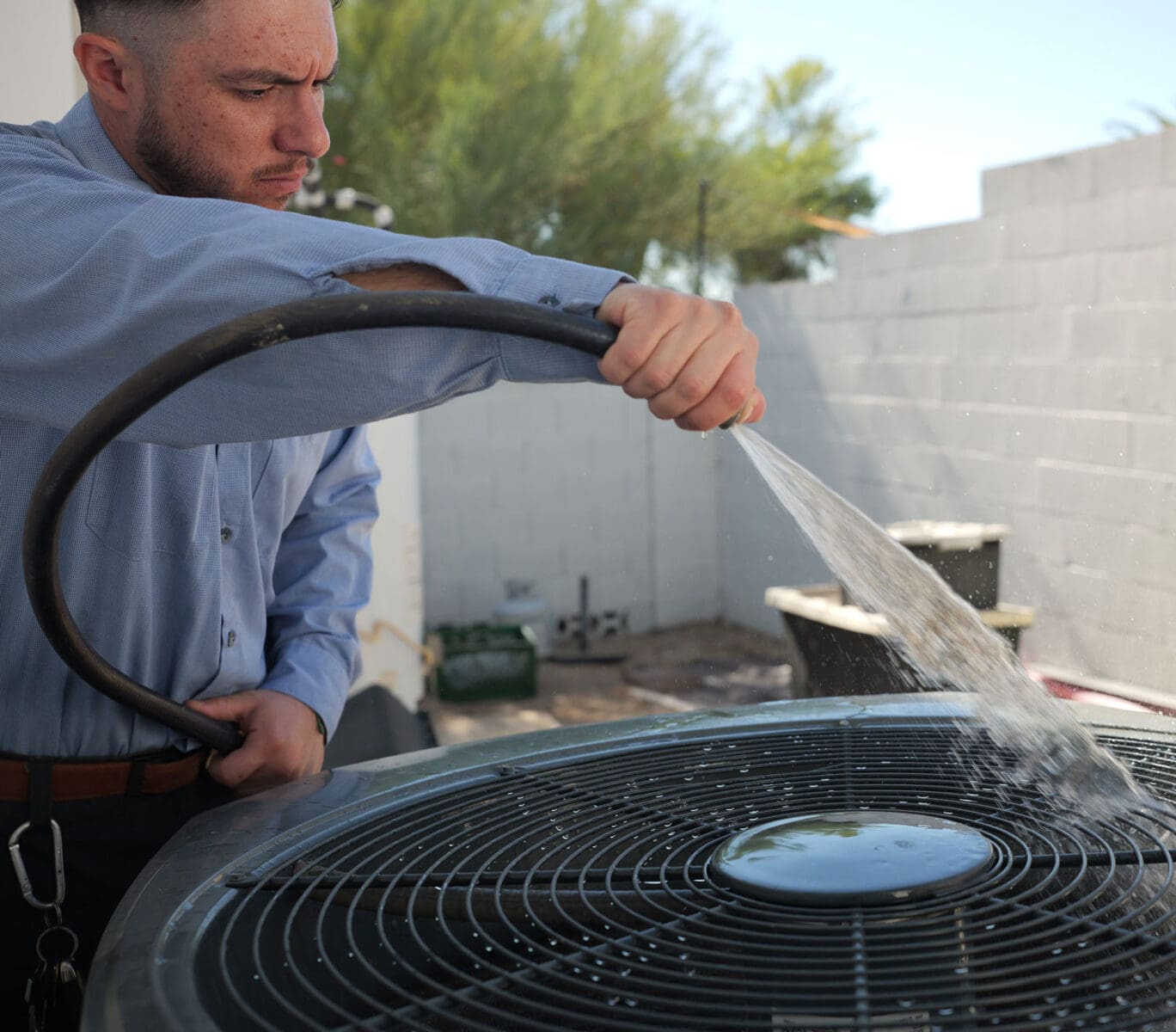
Dust, cottonwood fluff, and micro debris clog fins on the outdoor coil. Phoenix wind pushes grit into the coil field. High head pressure forces the compressor to draw more amps. Run time extends because heat does not shed fast enough. Field readings in North Mountain and Paradise Valley Village often show elevated condensing temperatures on fouled coils. A proper coil wash can drop discharge pressure, lower amp draw, and shave meaningful kWh in one visit.
Low airflow across the evaporator coil wastes power
Restricted return air starves the evaporator. Common causes include undersized returns, clogged MERV filters, collapsed flex duct, and dust matting on the coil face. The system runs longer to reach setpoint. The evaporator can ice over, and copper refrigerant lines frost near the air handler. Many Phoenix homes target about 350 to 400 CFM per ton. Measured static pressure above 0.8 in. W.c. Often flags duct or filter restrictions. Clearing the bottleneck brings coil temperature back into range and shortens cycles.
Refrigerant leaks shift the entire thermodynamic balance
Small R-410A leaks at flare fittings or service valves in split systems, heat pumps, and rooftop units cause a cascade. The evaporator coil runs too cold and can freeze. The system blows warm air once the ice forms. The compressor runs extended cycles under poor superheat and subcooling conditions. Energy per degree of cooling shoots up. A proper repair includes leak search, brazing or component replacement, evacuation to 500 microns, accurate charge by weight, and dial-in of superheat or TXV subcooling.
Failing start capacitors and contactors waste starts
Phoenix heat is hard on electrical parts. Start capacitors and contactors degrade in rooftop package units and condensers on south walls. The compressor struggles to start, stalls, or short cycles. Each failed start is a surge of wasted current and mechanical stress. Replacing weak capacitors and pitted contactors cuts nuisance trips and reduces peak amp spikes. Day & Night service trucks carry heavy-duty start capacitors and universal contactors to finish most fixes on a first visit.
Blower motor and ECM faults lengthen every cycle
Variable-speed ECM motors and PSC blowers both fail in Phoenix attics due to heat soak. An ECM with failed module logic can run at incorrect RPM. That reduces airflow and runtime efficiency. A PSC with weak bearings drags and pulls extra amps. Either way, bills climb. Bench testing amp draw and verifying target CFM against static pressure tells the truth fast.
Thermostat misreads and short cycling stack costs
A thermostat mounted on a hot wall near a west-facing window lies to the system each afternoon. The unit starts and stops too often. Short cycles burn extra power on each start, reduce dehumidification, and raise peak demand. A relocation to an interior wall and correct cycle rate settings often pay for themselves in one summer month in areas like Biltmore and Arcadia.
Why Phoenix pushes AC systems harder than most cities
The Valley of the Sun amplifies every weakness. Air-cooled condensers reject heat to desert air that sits above 105°F for long stretches. Rooftop units (RTU) work in full sun at the hottest time of day near noon and 3 p.m. Attic ducts run through spaces hotter than the air they deliver to rooms. A small leak at a flex connection near Desert Ridge turns into thousands of BTUs lost into the attic each hour. That loss shows up on the utility bill from APS or SRP.
High nighttime lows keep systems running late and starting early. There is less off-time to cool motors and boards. Contactors weld shut sooner. Thermal expansion and contraction work solder joints. That is why preventive HVAC maintenance brings such strong returns in Phoenix zip codes like 85085 and 85048.
What higher bills look like in real Phoenix homes
A homeowner in Arcadia notices a $95 jump in July. The thermostat still reads 75, but the system runs nearly nonstop after 1 p.m. The condenser coil is matted with dust from a spring haboob. Head pressure sits 60 psi higher than expected. A coil wash, a new MERV 8 filter, and a condenser fan capacitor bring amp draw back into range. The next bill drops to normal for the same average daily temperature.
A small office near Chase Field with a 5-ton rooftop package unit sees a sharp spike. The unit short cycles and trips on thermal overload on hot afternoons. The start capacitor tests weak. The contactor is heat scorched. A new capacitor and contactor stabilize starts. The technician also cleans the condenser coil field. Runtime per hour shrinks, and the business sees a lower demand charge the next cycle.
A Paradise Valley Village home with a heat pump shows frost on the suction line. The homeowner set back the thermostat 10 degrees during the day, then pulled it down quickly at 6 p.m. The evaporator coil ices, airflow drops, and the unit consumes more power than the older bill profile. A charge correction after finding a slow leak at the Schrader core and guidance on a gentler setback solve it. The homeowner also upgrades to a programmable thermostat with adaptive recovery.
Measurable signs the AC is wasting energy
A professional diagnosis uses numbers. Two readings tell a lot: temperature split and total external static pressure. A healthy split in Phoenix often sits around 18 to 22°F under stable indoor humidity. Much lower means airflow is too high or the charge is low. Much higher can mean low airflow and a coil on the edge of freeze-up. Static pressure above spec points at a duct or filter issue. Add motor amp draw and compressor current, and the pattern becomes clear.
Technicians in North Phoenix often measure subcooling to confirm a TXV is metering well. If subcooling is far off target, the system either holds the wrong charge or sheds heat poorly due to a dirty coil or failed condenser fan. Superheat confirms evaporator performance and airflow. In a Phoenix August, these checks prevent guesswork and cut return visits.
Appliance types and how each fails under Phoenix load
Central air conditioners and split systems dominate homes through Maryvale and South Mountain. Heat pumps are common where winter heating is mild. Rooftop units serve many small commercial spaces along the Maricopa County urban corridor. Ductless mini-splits show up in Arcadia guest houses and North Phoenix sunrooms. Each type has a pattern under desert heat.
Split systems with air handlers in 150°F attics suffer blower module failures and insulation breakdown on copper refrigerant lines. Rooftop units pay a heat tax on boards, contactors, and start components. Ductless mini-splits run well when coils stay clean, but clogged filters or a fouled outdoor coil in full sun cause reduced capacity and long runtime. Package units seen near Papago Park carry extra coil-soiling from dust and need regular cleanings to hold SEER.
Brands Phoenix homes and businesses rely on
Day & Night technicians service all major brands across Phoenix, AZ. The team handles Trane, Carrier, Lennox, Goodman, Rheem, York, and Bryant daily. Many higher-end systems include Daikin, Mitsubishi Electric, and American Standard. Factory-authorized training matters under Phoenix loads. Warranty work benefits from correct OEM parts and procedures that protect SEER ratings and maintain manufacturer coverage.
For precision comfort in North Phoenix sunrooms, Mitsubishi ductless mini-splits often solve hot spots without touching the main duct system. For rooftop replacement in Tempe, Scottsdale, and Glendale, high-efficiency package units with ECM condenser fans help reduce demand spikes on 115°F days.
Why a tune-up pays back faster in the Valley
A full maintenance service does more than wash coils and swap filters. It checks refrigerant charge, blower speeds, total external static, motor amps, capacitor health, contact resistance at the contactor, and drain line performance. In Phoenix, the same system runs more hours per season than in mild climates. Small defects accumulate more billable waste. Bringing the system back to spec saves more kWh here than in cooler cities because each hour saved is worth more in the summer cycle.
Day & Night performs deep diagnostics on core parts that drive efficiency. That includes the compressor, condenser coil, evaporator coil, blower motor, expansion valve (TXV), contactors, relay switches, and thermostat logic. The goal is central air conditioning restoration, not short-term patching. A unit that meets design airflow and charge runs fewer hours and keeps bills in line with actual weather.
How duct issues add invisible costs
Duct leakage in Phoenix hurts twice. First, cool air leaks into a superheated attic. Second, the system pulls hot attic air into returns through gaps. Static pressure rises. The blower rides its curve at a less efficient point. Rooms near South Mountain and Desert Ridge with long runs and crushed flex report poor delivery and long cycles. A quick smoke test or pressure pan reading during a maintenance visit finds these faults. Sealing key joints and repairing crushed duct sections can cut runtime and stabilize room temperatures.
Drain line failures and safety switches that stop cooling
Clogged condensate lines trip float switches in air handlers and package units during high-humidity monsoon days. The system stops to protect the home from water damage. Homeowners sometimes respond by lowering the thermostat more or cycling power. That does not help. It lengthens later cycles and can cause freeze-ups. A proper clear-out and drain treatment, plus adding an access tee, keeps water moving and prevents nuisance shutdowns that lead to wasteful catch-up cycles.
Electrical supply realities in Phoenix neighborhoods
Older homes in Maryvale and Sunnyslope sometimes feed new high-efficiency condensers through undersized breakers or aluminum branch circuits with tired lugs. Heat expands connections and raises resistance. Voltage drop at start increases. The compressor may stall and retry. Each retry draws a heavy surge. A licensed, bonded, and insured contractor with ROC compliance evaluates lugs, breakers, and whip condition. Correcting these issues removes a hidden energy penalty and reduces nuisance trips.
What homeowners can check safely before calling
Some checks make sense before scheduling an AC repair Phoenix visit. These do not replace professional diagnostics. They help avoid a preventable service call and can expose simple causes of a high bill.
- Confirm a clean, correctly sized filter with arrows pointing in the airflow direction.
- Rinse debris off the outdoor coil with a garden hose from inside out if accessible and safe.
- Set the thermostat to a reasonable target and verify the fan is on auto.
- Open supply registers and returns fully, and remove rugs or furniture blocking them.
- Look for ice on the copper refrigerant lines. If present, set the system to fan only and call service.
Clear signs the AC needs service now
Power bills tell part of the story. The system often sends other signals too. If any of these show up in a Phoenix home or office, schedule service right away. Search emergency air conditioning repair near me if the system trips, blows warm, or will not start on a 110°F day.
- Short cycling with warm air from vents or a rising indoor temperature.
- Squealing or grinding from the blower or outdoor fan motor.
- Frozen evaporator coil or frosted suction line at the air handler.
- Water near the air handler or drain pan, or a tripped float switch.
- Breaker trips at start, or the condenser hums without the fan spinning.
What a professional repair in Phoenix looks like
A proper service call includes symptom-driven diagnostics. If the unit short cycles in 85021, the technician verifies line voltage, checks the start capacitor in microfarads under load, inspects the contactor for pitting, and measures compressor inrush current. If frost shows on copper lines in 85032, the tech checks airflow, filter condition, static pressure, and coil face cleanliness before connecting gauges. If the condenser runs hot near Papago Park, coil delta-T, subcooling, and fan motor amps lead the process.
Day & Night trucks arrive with common failure parts that Phoenix heat chews up each summer. That includes heavy-duty start capacitors, universal contactors, fan motors, relay switches, and TXV kits. Stock on the truck increases the chance of a first-visit fix during a heatwave. The goal is to stabilize operation, restore capacity, and control energy use for the next billing period.
Commercial cases across the Maricopa County urban corridor
Retail spaces near the Footprint Center and Chase Field rely on rooftop units that face direct sun. Filter changes slip. Coils turn gray. Tenants notice bills rise faster than foot traffic. A same-day coil cleaning, belt check, and contactor swap often cut runtime the same week. Offices in Tempe and Mesa commonly use packaged heat pumps. Misconfigured economizers or failed dampers mix in excess outside air. In a 112°F afternoon, that error adds massive load. Correcting damper position and recalibrating controls drops demand and improves comfort for staff.
Why AC repair Phoenix searches spike with the first 110°F week
The first real heatwave exposes weak capacitors, clogged coils, and low-charge systems citywide. Google searches for AC repair Phoenix jump in Ahwatukee Foothills, Desert Ridge, and Paradise Valley Village at the same time. Early maintenance in spring prevents the scramble. Bills stay predictable. Emergency calls drop. For families near Biltmore and Arcadia who travel in summer, returning to a stable, efficient system matters because empty houses run at setpoints without in-person oversight.
About Day & Night Air Conditioning, Heating, & Plumbing
Day & Night is a high-authority HVAC contractor serving Phoenix, AZ and nearby cities like Scottsdale, Chandler, Gilbert, Glendale, Peoria, Mesa, Tempe, and Paradise Valley. The company provides residential cooling solutions and commercial HVAC repair with a clear focus on safety and uptime in Valley conditions. Technicians are NATE-certified, uniformed, and trained on Trane, Carrier, Lennox, Goodman, Rheem, York, Bryant, and premium systems like Daikin, Mitsubishi Electric, and American Standard.
The company operates under full license, bond, and insurance with ROC #133378. BBB A+ standing reflects steady service to the community. Same-day service and 24/7 emergency AC repair support Phoenix homes and businesses through peak monsoon events and heat advisories. Fixed-price guarantees keep totals transparent, and permission-based repairs prevent surprises.
Neighborhood and zip code focus improves response time
Dispatch operates with geographic precision to reduce time-to-diagnosis. North Phoenix zip codes 85032 and 85050 see rapid emergency deployment. Crews cover 85018 across Arcadia and the Biltmore area in the shadow of Camelback Mountain. Teams near 85044, 85048, and 85085 serve Ahwatukee Foothills and fast-growing corridors north of Loop 101. Urban cores near the Heard Museum, Footprint Center, and the Arizona State Capitol get day-of coverage for rooftop units and split systems under load.
Technical choices that cut bills in Phoenix
Some upgrades and settings return strong savings in Phoenix weather. A programmable thermostat with gentle setpoint ramps prevents freeze-ups and high inrush events in the evening. High-efficiency condenser fan motors lower watts per BTU of rejected heat. Correctly sized MERV filters reduce pressure drop while protecting the coil. A TXV that meters well keeps evaporator pressure stable as loads shift during monsoon humidity spikes. Proper refrigerant charge matched to manufacturer subcooling targets locks in system efficiency.
For homes with rooms that stay hot, a ductless mini-split handles the extra heat load without overcooling the rest of the home. This reduces runtime on the main system. Many Arcadia remodels and North Mountain additions choose this path to solve comfort gaps and protect the main system’s energy profile.
Frequently asked questions about high summer bills in Phoenix
How fast should a home cool after a setpoint change? In 110°F weather, a healthy system often drops indoor temperature one to two degrees per hour if doors stay closed and sun exposure is managed. If the system struggles to drop even one degree and runs nonstop, it needs service.
Does higher SEER always solve the bill problem? Not if the system has duct leaks or an incorrect charge. A high-SEER unit undercharged or starved for airflow will still waste energy. Fixing the basics unlocks the rated efficiency.
Is a dirty indoor coil common in Phoenix? Yes. Return air dust and attic conditions cause matted debris on the evaporator. A cleaning reduces static pressure and raises heat transfer. Many homeowners never see this coil, so the problem lingers until a tech inspects it.
Why do bills stay high at night? In Phoenix, overnight lows may sit above 90°F. Attics hold heat. The system never fully rests. Correct airflow, clean coils, and tight ducts reduce runtime even under hot nights.
Why this matters for safety during Phoenix heat advisories
High bills hurt the budget, but an AC in distress also risks a full outage during a warning day. That can be a medical concern. A tune-up or repair is more than comfort. It protects people and property. For elderly residents in Sunnyslope, infants in Maryvale, or remote workers in Desert Ridge, reliable cooling is critical. Quick service from a trusted contractor keeps homes safe when grid demand peaks and outdoor air scorches.
Service positioning for high-intent needs
For urgent cooling issues, high-intent homeowners and property managers search AC repair Phoenix or emergency air conditioning repair near me. Day & Night responds 24/7. The team handles refrigerant leaks, burned out compressors, frozen evaporator coils, squealing fan motors, thermostat malfunctions, and clogged condensate drain lines. Technicians service central air conditioners, heat pumps, ductless mini-splits, split systems, package units, and rooftop units across Maricopa County. The priority is fast restoration and stable performance under Phoenix heat.
Local proof points that improve confidence
From condos near Phoenix Sky Harbor International Airport to homes off 32nd Street in 85016, the company’s records show shorter cycle times and lower amps after coil cleanings and charge corrections. Routine static pressure corrections in Ahwatukee Foothills homes with long duct runs reduce blower noise and bills. Businesses near Chase Field report steadier indoor temperatures and fewer demand spikes after contactor and capacitor refreshes on rooftop units.
Day & Night Air Conditioning, Heating & Plumbing 3669 E La Salle St,
Phoenix, AZ 85040 (602) 584-7758 www.dayandnightair.com AZ Licenses: ROC335883 | ROC335884 Google Maps | Facebook | Instagram | LinkedIn